Aspects of Belt Conveyor Design
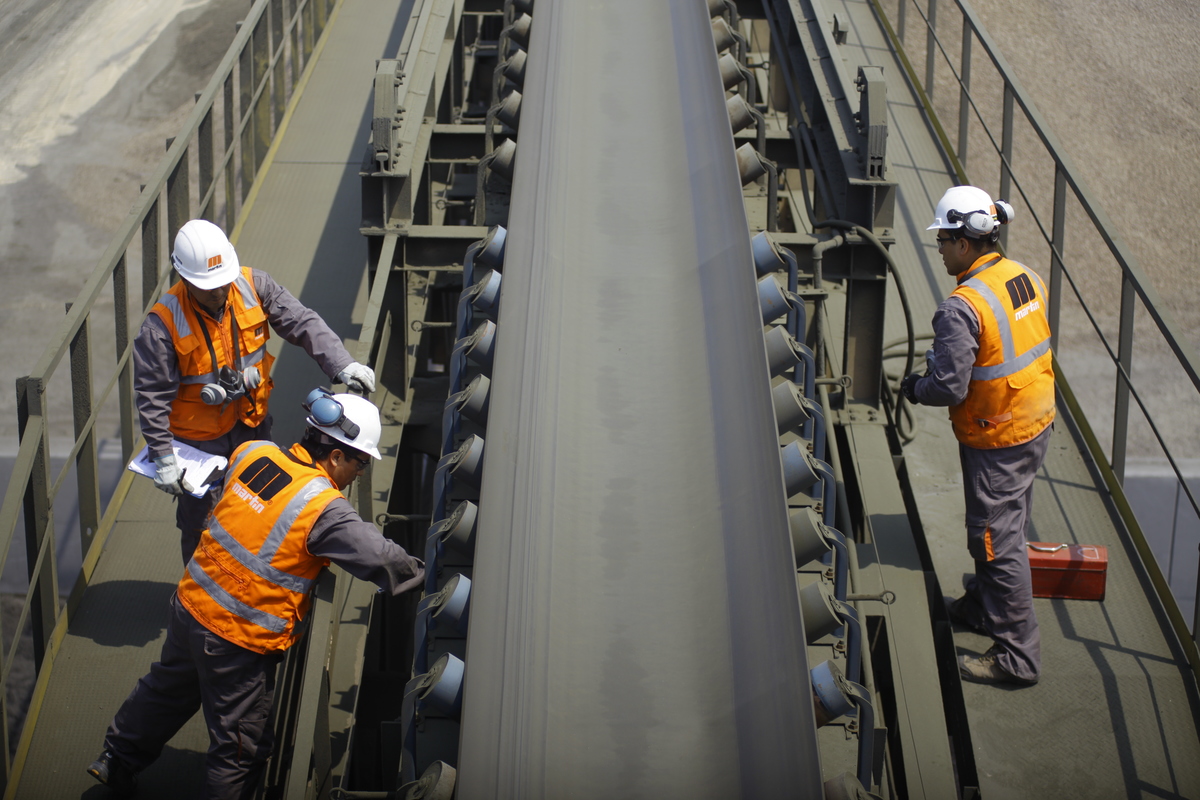
The major points in selection and design of a belt conveyor are:
Checking/determining capacity of a conveyor.
Calculating maximum belt tension required to convey the load and selection of belt.
Selection of driving pulley.
Determining motor power.
Selection of idlers and its spacing.
Above points have been discussed below in respect of flat as well as troughed belt conveyor.
Study material for DGMS and other mining engineering exams
WhatsApp channel: Miners Adda
Checking/Determining Conveyor Capacity
Belt width This basically means to check at what rate (tons/hrs. or units/min) a belt conveyor of a given belt width and speed can convey a particular bulk material or unit loads. Conversely, it is to find out the size and speed of the conveyor to achieve a given conveying rate.

The cross sectional area of the load on a flat belt is
F1 = bh/2
= (1/2)(0.8B x 0.4Btanφ)
= 0.16B2tan(0.35φ)
Therefore, conveying capacity "Qf" of a flat belt conveyor is given by
Qf = 3600F1Vγ
= 576B2Vγtan(0.35φ)t/hr
where
g = bulk density of material in tons/m3
V = velocity of belt in m/sec
B = belt width in metres.
Belt Speed Recommended belt speed depends on the width of the belt as well as lump size factor of the bulk material, its air borne factor and also its abrasiveness factor. IS: 11592:2000 gives the maximum recommended belt speeds for different sizes of belts based on ‘‘speed factor’’ (speed factor = lump size factor + air borne factor + abrasiveness factor).
Belt Tension
In belt conveyor, the motive force to draw the belt with load is transmitted to the belt by friction between the belt and the driving pulley rotated by an electric motor.

T1/T2 = eμα
where T1 = belt tension at tighter side
T2 = belt tension at slack side
a = wrap angle in radian
m = coefficient of friction between pulley and belt
T1 – T2 = ‘‘Te’’ is the effective pull in the belt which is pulling the loaded belt against all resistances against the belt movement.
Te = T1 - T2 = T2(eμα -1)
Selection of Driving and Other Pulleys
The large diameter driving and tail end pulleys are generally fabricated from steel plates. The pulley shafts are made integral with the barrel. The barrel and journal portions are machined in one setting to make them concentric. The pulley faces are given a ‘‘crown’’ of around 0.5% of the pulley diameter, but not less than 4 mm.
Diameter of pulley is selected based on the construction (number of plies which is proportional to carcass thickness) of the belt used. As a thumb rule, diameter ‘D’ can be approximated from the relation, D ≥ ki, where i = number of plies of belt, and k = 125 to 150 for i between 2 to 6, and k = 150 for i between 8 to 12. Calculated ‘D’ is rounded off to the larger standard sizes of 250, 315, 400, 500, 630, 800,1000,1250,1400,1600, 1800 and 2000 mm.
The length of the barrel is kept 100 mm to 200 mm more than the belt width.
The drive pulley may be covered (lagged) with a layer of suitable material like rubber, polyurethane, ceramics etc, whenever necessary, to increase the coefficient of friction between the pulley and belt.
The thickness of such lagging may vary between 6 to 12 mm.
Motor Power
The power required at the driving pulley just for driving the belt is given by the formula:
Pd = TeV/1000 kW
where Te = effective tension
= (T1 – T2) in Newton
V = belt speed, m/sec
Pd = driving power, kW
However, the actual power requirements, considering the wrap resistance between belt and driving pulley, and driving pulley bearings resistance, the actual motor power, PA is given by
PA = (TeV/1000) + [(Rwd + Rbd)V/1000] kW
where Rwd = wrap resistance between belt and driving pulley.
Rbd = driving pulley bearing resistance.
Selection of Idlers
Depending on the type of belt conveyor, the carrying idlers can be troughed or straight, while the return idlers are generally always straight. The major selection criteria are the roller diameters and spacing of these idlers.
The range of idler diameters to be selected depends on belt width, maximum belt speed and type of materials to be conveyed.
Spacing for carrying and return idlers also depends on belt width, and bulk density of the material to be conveyed.
Example
A conveyor transported the coal at the rate of 220 te/hr is 600 m long moving up a gradient of 1 in 60. If the belt width (W) is 0.75 m, and cross-sectional area of the material is 0.1 W2, determine the belt speed. The bulk density of coal 0.8 te/m3.
Solution
T = 220 t/hr = 0.061 t/s
W = 0.75 m
a = 0.1W2
= 0.1 x 0.752 = 0.056 m2
b = 0.8 t/m3
T = abV
Hence, 0.061 = 0.056 x 0.8 x V
From this, V = 1.36 m/s
Example
For a 150 m long chain conveyor, the component of power required to move coal against gravity along an inclination 15° is 5 kW. Hourly capacity of the chain conveyor will be ____.
Solution
P = 5000 Watt
L = 150 m
Angle = 150
Force, F = mg sinθ
P = Fv = F x (distance/time)
For 1 sec
P = F x distance
= mg sinθ x distance
∴ 5000 = m x 9.8 x sin150 x 150
Giving m = 13.14 kg in one second.
Hourly capacity/hr = Mass handled/hr
= 13.14 x 3600 = 47310 kg
= 47.3 te
Example
In a conveyor belt drive the tension on the tight side is double that on the slack side. If the value of µ is 0.3. find the angle of lap required if the belt is not to slip on its driving drum.
Solution
T1/T2 = eμ(θ/57.3)
where
T1 = tension on the tight side
T2 = tension on the slack side
μ = coefficient of friction
lap θ = wrapping angle or the angle of lap in degrees
Here T1/T2 = 2
2 = e0.3(θ/57.3)
By trial and error,
θ = 1320
Or from the given options, 1320 satisfies the equation.
Example
Two belt conveyors load a ground bunker, each at a rate of 400 tph which is initially filled with 10000 t of coal. Coal is discharged from the bottom of the ground bunker onto a belt conveyor at a rate of 1200 tph. The time elapsed in hours before the bottom conveyor starts to operate below its rated capacity is _____.
Solution
No. of belt conveyors = 2
Loading rate = 400 tph
Initially quantity in bunker = 10000 t coal
Rate of Coal discharged from ground bunker onto belt conveyor = 1200 tph.

Capacity of 1st and 2nd belt conveyor (q) = 400 tph
Capacity of 3rd belt conveyor (Q) = 1200 tph
Initial mass of coal in the bunker (M) = 10000 tonne
Doing mass balance
M + q x T + q x T = Q x T
10000 + 2 x 400 x T = 1200 x T
∴ T = 25 hr.
Example
A flat belt conveyor is carrying coal of bulk density 1 tonne/m3 at a rate of 400 tonne/h. The belt speed is 3 m/s. Coal is spread over the belt covering 80% of the belt width in a shape of a triangle. If the pile height is 1/4 of the belt width, the width of the belt in mm is
Solution
T = abV
T = 400/3600 t/s
a = area of triangle of base 0.8W and height (W/4)
= (1/2)(0.8W)(W/4)

b = 1 t/m3
V = 3 m/s
∴ 400/3600 = (1/2)(0.8W)(W/4) x 1 x 3
Giving W = 0.609 m = 609 mm
Example
A 35.0 kW motor transmits power to a pulley of 600 mm diameter, which rotates at 400 rpm to drive a flat belt. The tension in the tight side is 2.5 times of the slack side. Neglect all transmission losses. If the maximum allowable tension is 8.0 N per mm of belt width, then the minimum width of the belt in mm, is –––– . (round off up to 2 decimals).
Solution
V = πDN/60
= 3.14 x 0.6 x 400/60
= 12.56 m/s
T1/T2 = 2.5
T1 = 8W Newton (W is width of belt in mm)
∴ T2 = T1/2.5 = 8W/2.5 = 3.2W
Power = FV
∴ 35,000 = (8W - 3.2W) x 12.56
∴ W = 580 mm
Example
What would be the capacity of a flat belt conveyor in ton/ hour, if the bulk density of material is 0.8 t/m3, belt width is 1.0 m, angle of repose is 45° and velocity is 100 m/min?
Solution
T = abv
= (1/2)(width x pile height) x b x v
where b is bulk weight and v is velocity.
Pile height = 0.5 tan450
= 0.5 m x 1 = 0.5 m
T = (1/2)(1 m x 0.5 m) x 0.8 t/m3 x (100 x 60 t/hr)
= 1200 t/hr
Subscribe to our newsletter for updates on DGMS and other mining engineering exam
Study material for DGMS and other mining engineering exams
WhatsApp channel: Miners Adda


Comments