Blasting and Use of Detonators in Mines
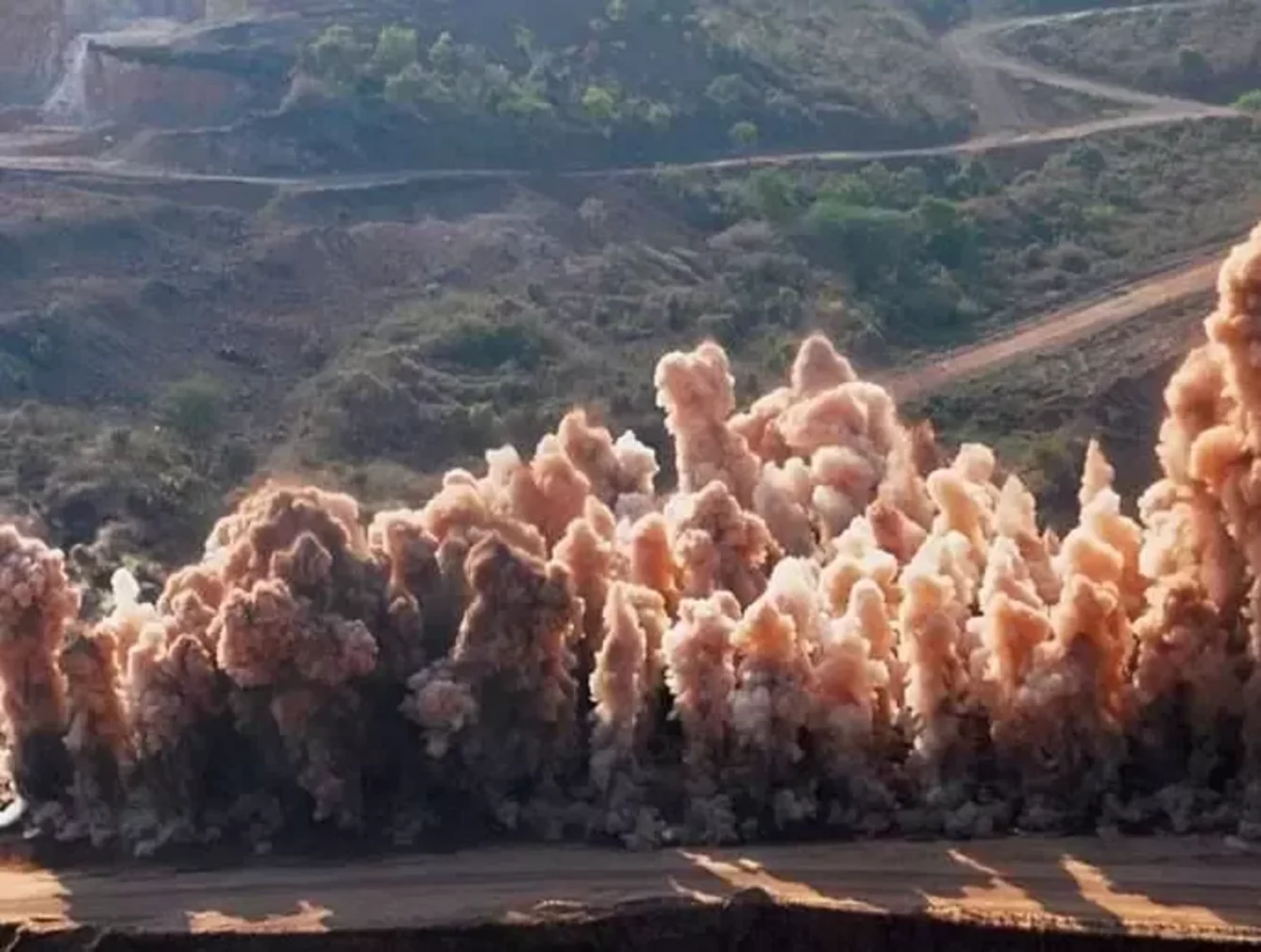
Blasting in underground coal mines is a specialised operation. The proper use of explosives is vital to safety, influences the cost of production, and in many cases, has a direct bearing on the quality of the coal produced. The possible occurrence of highly inflammable mixtures of methane and air and exposable dusts has led to special statutory requirements for explosives and their use in such mines.
Basically two methods of working are followed in coal mines - Room (also called Bord) and Pillar, and Longwall Methods. Different blasting practices are followed in the development stage and in removing pillars so formed.
In drives or in mining out a room, the coal is cither blasted off the solid where the coal is blasted from the solid seam which has but one free face, or cut coal is blasted in which the seam has previously been cut to provide at least one more free face.
Blasting in underground coal mines is a specialised operation. The proper use of explosives is vital to safety, influences the cost of production, and in many cases, has a direct bearing on the quality of the coal produced. The possible occurrence of highly inflammable mixtures of methane and air and exposable dusts has led to special statutory requirements for explosives and their use in such mines.
Basically two methods of working are followed in coal mines - Room (also called Bord) and Pillar, and Longwall Methods. Different blasting practices are followed in the development stage and in removing pillars so formed.
In drives or in mining out a room, the coal is cither blasted off the solid where the coal is blasted from the solid seam which has but one free face, or cut coal is blasted in which the seam has previously been cut to provide at least one more free face.
Blasting off the solid (Solid blasting)
The first essential in the technique of drilling and blasting solid coal development headings is to create a free face for the explosive to blast into. The holes (which will form the CUT) are drilled so that relief of burden is towards the free face. The remaining holes in the round are drilled so that they break towards the cut. Short delay detonators are used to control the sequence of firing of holes. The maximum burden placed on shot holes with this method should not exceed half their depth and normally, is established by field trials since breakage characteristics vary from seam to seam. Holes should be spaced to ensure that one does not rob the other and that the explosive charges will be adequately confined for maximum efficiency and safety.
Three methods of solid blasting off the development headings have been successfully used.
Wedge cut pattern In wedge cut or V-cut pattern 'breaking in', 'cut' or 'opening' holes are drilled towards each other to form a wedge, the angle and depth of which depends on the prevailing conditions, hardness of coal etc. The wedge cut pattern will reduce the number of delays needed.
Fan cut pattern In fan cut method, the holes are drilled in a fan like pattern initiating the shortest holes first with the delay sequence rising towards the longest holes.
Drag cut pattern The drag cut is in effect a type of 'vertical' fan cut in which pairs of holes are drilled towards either the floor or the roof of the excavation. This pattern is less commonly used.
Blasting on Longwall face
On a longwall face, the shotholes are drilled at an angle of 45°- 60° to the face; a coal face 2.4 m high requires 3 rows of holes and distance between holes in the same rows of holes should be nearly 1.2 m. A typical layout of shotholes on a longwall coal face for blasting off the solid is shown in following figure.

Depth and pattern of blast holes
The depth of vertical blast holes in coal is generally equal to the height of the bench. In hard rock like sandstone, laterite, hematite, etc. the depth should be 0.5 to 1 m deeper below the level of bench floor. This loosens the toe. In any case, the hole should terminate in hard rock and not in the soft one; otherwise the force of explosive is wasted.
Burden is the minimum distance from the face to the blasthole (the term usually refers to burden at the top of the face).
Toe is the projection of the bottom of a face beyond the crest. Sometimes the bottom edge of the bench is referred to as toe.
In hard rocks like laterite and hematite the spacing and burden vary from 0.3 to 0.4 times the height of bench. In less hard rocks like coal and sandstone, the spacing and burden vary from 0.5 to 0.8 times the height of bench. The exact dimensions depend upon the hole diameter, type of explosive used, type of the rock, nature of rock consolidation and the angle of cleats or laminations with the blast hole.
Fragmentation
Primary fragmentation occurs during the detonation phase. The shock waves exceed the compressive and the tensile strength capacity of the rock, and the rock is crushed and pulverized close to the drill hole, and radial cracks will be created out from the hole to a certain extent (equal to 4 – 5 times the hole radius). The gas pressure will penetrate new cracks and existing fissures and joints, loosening the rock mass and throwing it out and over the bench floor.
Secondary fragmentation breakage starts with the throw when fragmented material accelerates out from the bench.
Controllable factors which influence primary fragmentation:
Drill hole diameter
Mass of explosive charge
Stress waves’ peak values
Charge distribution in the bench
Detonators
High explosives are initiated by detonators or detonating fuses. A detonator is a small copper or aluminium tube containing essentially a small auxiliary charge of special explosive. A chemical reaction initiated by a flame or electric current in the special explosive can build up very rapidly into an explosion of sufficient intensity to project a detonation wave throughout a high explosion enclosing the detonator.
Detonators are of the following types :
Plain detonators
These are fired by safety fuses, the spark or "spit" from the fuse causing the detonator to explode; these are sometimes called "ordinary" detonators.
Ordinary electric detonators
These are fired by passage of electric current through the detonator. They are further subdivided as : (a) Low tension detonators, and (b) High tension detonators (not generally used in mining).
Ordinary electric detonators are of instantaneous type, i.e. without any delay element. They are of copper or aluminium tubes.
Delay detonators
These are essentially low tension electric detonators with a delay element, the object in their use being to phase the firing of shots, so that time and effort are saved in charging and firing several successive rounds of shots.
These are subdivided as :
Half second or long delay detonators, and
Milli-second delay detonators (also known as short delay detonators).
In appearance and composition, this is like the L.T. detonator. [The L.T. detonator described above is of instantaneous type; the moment voltage is applied to it, the detonator explodes and along with it, the (enclosing explosive. A delay detonator has a delay element introduced between the fuse head and the priming charge. (see figure).

(a) Section of delay detonator (b) Ordinary electric detonato
The delay element consists of a copper or brass sleeve filled with a special composition which bums at a specified rate and the delay is obtained by varying the length of the sleeve containing the special composition.
Permission from the D.G.M.S. is required before using delay detonators in underground coal mines. Delay detonators and non delay detonators should not be kept in the same box.
Safety Fuse
A safety fuse which looks like a cord consists of a core of fine grained gunpowder wrapped with layers of a tape or textile yarn and waterproof coatings. The burning speed is usually 100 to 120 sec/ metre. When one end of the fuse is ignited, it carries the flame at a uniform rate to ignite gun powder or to detonate an ordinary detonator which is turn can detonate a high explosive.
Detonating Fuse
For shallow depths, say less than 3 m, and for small number of holes, a detonator is inserted in the cartridge itself and detonated by ignition of safety fuse or in the case of elec. detonator, by an exploder. For a large no. of holes blasted at a time in mechanised quarries and in U/G coal mines electric detonators are used. A deep hole in a quarry needs a long length of detonator leads and to avoid this it is common to use a detonating fuse like cordtex (trade name of ICL The fuse consists of a core of PETN enclosed in a tape which is wrapped with cloth. The fuse is then completely enclosed in a tubular cover of plastic material which is white for Cordtex and orange for Geocord detonating fuse (ICI). The detonating fuse looks like a plastic cord; its external dia. is about 5 mm and weight about 20 g per metre length. It has a velocity of detonation of 6500 m/sec. and it is practically instantaneous in its action.
Detonating Relays
In opencast workings, detonating relays using detonating fuse for initiation provide a non electric delay firing system. This method avoids the electrical connections which are required when using delay detonators. A detonating relay is essentially an assembly of two open-ended delay detonators coupled together with flexible neoprene tubing in an aluminium sleeve suitable for crimping into a detonating fuse.
Example
In a surface mine, blasting is carried out using electronic detonator and cartridge emulsion explosive with following details:
Burden = 3.5 m
Spacing = 4.5 m
Bench height = 10.0 m
Subgrade drilling =1.0 m
Stemming = 4.0 m
Linear charge concentration =16 kg/m
Cost of one detonator = Rs. 800
Cost of explosive = Rs. 30 per kg
The cost of blasting material per cubic meter of blasted rock, in Rs., is ____ (rounded off to 2 decimal places)
Solution

The volume of rock blasted per hole
V = Burden x Spacing x Bench height
= 3.5 m x 4.5 m x 10.0 m = 157.5 m3
Hole length = 10.0 m + 1.0 m = 11.0 m
Explosive column length
= 11.0 m - 4.0 m = 7.0 m
Explosive weight = 7.0 m x 16 kg/m = 112 kg
Cost per hole = Cost of detonator + (Explosive weight x Cost per kg of explosive)
Cost per hole = ₹ 800 + (112 kg x ₹ 30/kg)
= ₹ 800 + ₹ 3360 = ₹ 4160
Cost per m3 = Cost per hole/Volume per hole
= 4160/157.5 = ₹ 26.4 /m3
Example
In a development coal face, 12 holes are drilled and charged with explosive. Holes are initiated with electric delay detonators connected in series. The length of a detonator lead wire is 1.5 m. The length of the blasting cable is 120 m.
Data are as given:
Resistance of each detonator: 1.48 Ω
Resistance of lead wire: 0.04 Ω/m
Resistance of one wire of the blasting cable: 0.009 Ω/m
The total resistance of the circuit in Ω, is ____ (round off up to 2 decimals).
Solution
There are two blasting wires, 12 lead wires and 12 detonator.
Resistance of blasting wire
= 2 x 0.009 x 120
= 2.16 Ω
Resistance of 12 lead wires
= 12 x 0.04 x 1.5
= 0.72 Ω
Resistance of 12 detonators in series
= 12 x 1.48 = 17.76 Ω
Total resistance = 2.16 + 0.72 + 17.76
= 20.64 Ω
Example
In an opencast coal mine, blast vibrations are measured at two locations. A and B simultaneously for a maximum charge per delay (Q) of 1200 kg as given.

Assume the relation
PPV = K(D/√Q)-β
where, 𝐾 and 𝛽 are site constants. The PPV in mm/s, at a distance of 200 m from the blast face, is ______. (round off up to 2 decimals).
Solution
Taking log on both the sides (as without taking log, it would be difficult to solve equations as it would need a trial and error approach).
log(PPV) = log K -βlog(D/√Q)
Now, log 112.5 = log K - β(100/√1200)
i.e. 2.05 = log K - 0.46β (1)
Similarly
log 20.3 = log K - β(300/√1200)
i.e. 1.31 = log K - 0.94β (2)
Solving (1) and (2)
K = 575.4, β = 1.54
Now from given data
log (PPV200) = log(575.4) - 1.54log(200/√1200)
∴ PPV200 = 38.
Subscribe to our newsletter for updates on DGMS and other mining engineering exam
Study material for DGMS and other mining engineering exams
WhatsApp channel: Miners Adda


Comments