Properties of Explosives
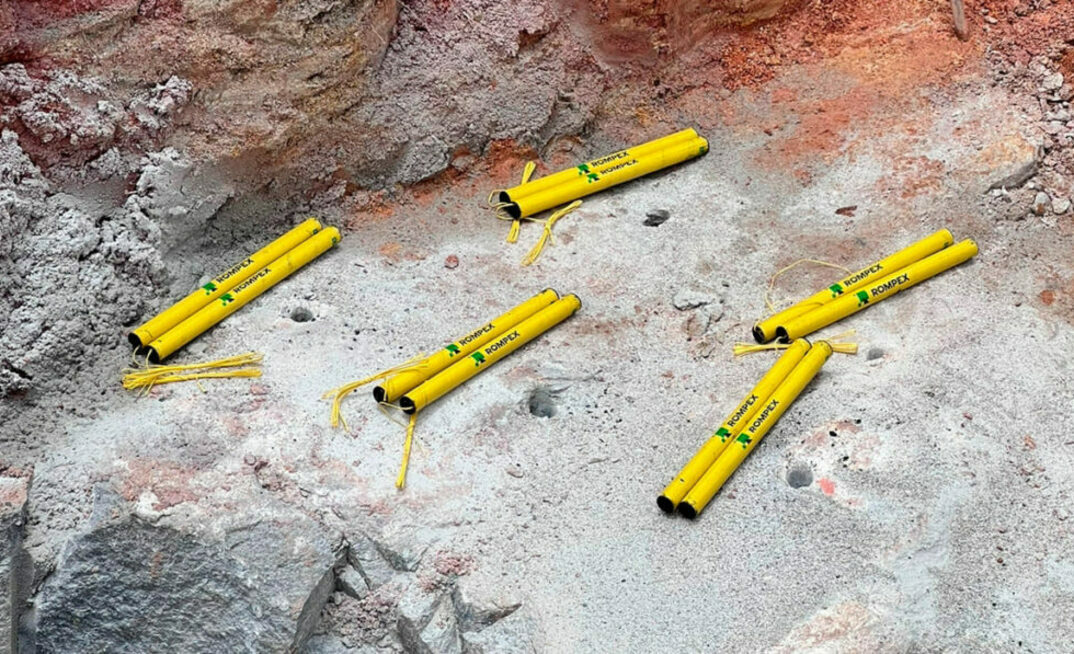
Each explosive has certain specific characteristics or properties. Some of the principal properties of explosives which influence the ultimate choice are:
Detonation velocity; strength energy; detonation pressure; density; safety in handling; storage qualities; water resistance; sensitivity; sensitiveness; medical aspects; inflammability; resistance to freezing; permissibility.
Detonation Velocity
The detonation velocity is a measure, in meters per second or feet-per-second, of the speed at which the detonation wave travels through a column of explosives. Many factors affect the detonation velocity such as explosive type, diameter, confinement, temperature, and priming.
Type
The detonation velocities of today's commercial explosives range from about 1500 m/s e.g. ANFO in small diameter holes and certain permissibles to more than 6700 m/s e.g. detonating cords and cast-primers. Every explosive has an ultimate or ideal velocity known as hydrodynamic velocity, which is the steady-state velocity of the explosive. As a general rule, the higher the velocity the greater the shattering effect; thus when harder rock is to be blasted, a higher velocity explosive should be chosen. It is to be noted that velocity is not the solitary property which influences the power of an explosive.
Diameter
Depending upon the type of explosive up to a certain diameter the velocity of detonation of an explosive is influenced by the diameter. In general, the larger the diameter the higher the velocity until the steady state velocity of the explosive is reached. Every explosive also has a 'critical diameter' which is the minimum diameter at which the detonation process, once initiated, will support itself in the column
Degree of confinement
Generally, the greater the confinement of an explosive, the higher the detonation velocity. This is particularly true for products such as ANFO and some watergels in small diameter boreholes. Depending on the type, the degree of confinement has less effect on the velocity as the diameter of the explosive increases. If the diameter is small enough, the detonation may ultimately decay and fail. With the increase in the diameter of the explosive, however, the degree of confinement gets less and less effective.
Temperature
Depending on the type of explosive, changes in its temperature affect the velocity of the detonation. A decrease in temperature will decrease the sensitivity of any explosive.
Priming
It is essential that adequate priming is ensured so that the explosive may reach its maximum velocity as quickly as possible. Inadequate priming can result in the failure of the explosive to detonate, a slow build-up to final velocity, or a low velocity detonation.
Explosive Energy
The performance of an explosive is not determined simply by knowing the total energy released by the explosive. It depends also upon the rate of energy release and how effectively the energy is utilised in fragmenting and moving the material being blasted. Both the explosive properties and the properties of the material being blasted influence the effectiveness of an explosive. Some of the current tests or calculations to measure and characterise an explosive energy are the various underwater tests, the pressure time measuring technique in the rock, and the theoretical calculation techniques.
Density
The density of explosives is expressed in g/cm3. In general commercial watergels. emulsions and nitro-glycerine based explosives commonly used are in the range of 1.10 to 1.35 g/cm3.
Critical Density
An explosive sensitivity can be reduced or destroyed by too much increase in density. If the density becomes too high and the 'critical density' is exceeded then even a good primer may not detonate the blasting material.
Detonation Pressure and Explosion Pressure
The detonation pressure, usually measured in kilobars, is generally considered as the pressure in the shock zone ahead of the reaction zone. When an explosive detonates, this tremendous pressure is released, practically instantaneously, in a shock wave which exists for only a fraction of second at any given place. The sudden pressure thus created will shatter rather than displace objects and is generally accepted as providing to an explosive an ability called brisance. This brisance or shattering effect is dependent upon the suddenness with which the gaseous products of an explosive are liberated. The detonation pressure is a function of the density, the detonation velocity, and the particle velocity of the explosive.
The detonation pressure is different from the explosion pressure, which is the pressure after adiabatic expansion back to the original explosive volume. The explosion pressure is theoretically about 45% of the detonation pressure. The effective explosion pressure in blasting depends on how well the explosive fills the holes.
Water Resistance
The ability of an explosive to withstand water penetration, termed as water resistance, vary widely for the various explosives. In many blasting situations explosives have to remain under water for long periods of time. Even in case of common rock blasting operations the drill holes are full of water. Water resistance is generally expressed as the number of hours a product may be submerged in static water and still be detonated reliably.
Sensitiveness
Sensitiveness of an explosive is a measure of its propagating ability. For NG-based explosives and some slurries it is the distance in inches or centimetres over which one half of 25 mm x 200 mm cartridge would propagate to another one-half of a 25 mm x 200 mm cartridge when both halves with the cut-ends facing were enclosed in a paper tube and shot unconfined. This is termed as 'gap sensitivity'.
Example
An explosive with a density of 1.2 g/cm3 has a heat of explosion equal to 900 cal/g. If the heat of explosion of ANFO with density of 0.8 g/cm3 is 950 Cal/g, the bulk strength of the explosive relative to ANFO is _____.
Solution
Relative bulk strength
= str1 x SG1/stranfo x SGanfo
= 900 x 1.2/(950 x 0.8)
= 1.42
Example
An HMX explosive having Velocity of Detonation (VOD) of 10500 m/s is tested by D’Autriche method with a detonating fuse of VOD 7000 m/s, as shown in the figure. The impression mark on lead plate will be obtained at a distance (L), in m, from the midpoint of the fuse, is_____.

Solution
L = Vf x S/(2Ve)
= (7000 x 1)/(2 x 10500)
= 0.33 m
Subscribe to our newsletter for updates on DGMS and other mining engineering exam
Study material for DGMS and other mining engineering exams
WhatsApp channel: Miners Adda


Comments