Rope Haulage Systems
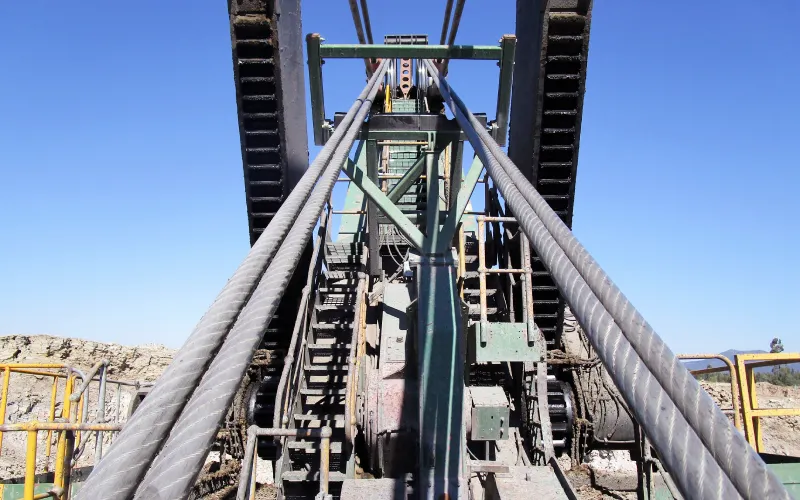
This system is simple in construction and maintenance. It can suit any gradient and curvature of roadways. Even gravity can assist it to the extent that in hilly terrain it could be installed. This type of arrangement, when installed in an incline, it is known as self-acting-incline.
Main drawbacks of rope haulage are large amount of manual work required at the terminals; absence of complete mechanization and automation of all operations, less reliability and complicated work involved in negotiating branches and junctions. This makes the system inadequate for modern mines and tunnels. This system could be used for low capacity mines having low degree of mechanization. It finds its application as a auxiliary haulage for material transport in some mines. However, on steep gradients, where belt conveyors cannot be deployed, its use is almost mandatory; and it is used in conjunction with cage and skip hoisting operations in shafts and inclines.
Direct (fig. a, b), main and tail (fig. c) and endless (fig. d) are the principal designs of the rope haulage that are used.

Direct Rope Haulage
Single Drums Direct Rope Haulage
This is simplest system of rope haulage. It consists of one track, one rope & one drum which are connected to a motor through gears. One end of the rope is connected with the train of tubs on the track & another end of the rope is connected to the drum. When the drum rotates situated at the top of the incline, the loaded tubs moves upwards. But for the downward journey of the empty tubs it does not require any power because a tub moves downward due to their own weight. The system can be on inclines steeper than 1 in 12 & the speed of the haulage is 8 – 12 kmph.
Double Drum Direct Rope Haulage
It consists of two drums, two ropes & two tracks but only one driving motor. One end of each rope is connected with two drums & another end of rope is connected with the set of tubs. In such a way that when one set of tub is at incline top, the other set is at incline bottom. The two drums are connected with each other. When drum rotates, the rope coils on one drum & uncoils from another drum. It can be used if inclination is more than 1 in 12. The speed of the system is 8 to 12 kmph.
Main & Tail Rope Haulage
In this system the haulage engine provided with two separate drums, one for main rope which hauls the loaded tubs up the gradient & one for tail rope which hauls the empty tubs down the gradient. When one drum is in gear, the other drum revolves freely but controlled. The main rope is approximately equal to the length of the incline & tail rope is twice this length. The system can be used if the gradient is unsuitable for the use of direct rope haulage. Its speed is 15 – 18 kmph.
Endless Rope Haulage
This system consists of double track, one driving pulley & one return pulley. An endless rope passes from the driving pulley which is situated at the inby end & back again to the driving pulley. One track is used for loaded tubs & another track is used for empty tubs. Rope moves in one direction only with the speed of 3-7 kmph. Only one train of tubs is attached to the rope at a time but some times a set of tubs can be attached to the rope. The system is used where the gradient is less, generally less than 1:12 or where the ground is undulating. A squirrel cage motor is commonly employed.
Under Rope Endless Rope Haulage
If the rope passes below the tubs, it is known as under rope endless rope haulage. In this system there is more wear & tear to this rope but also there is an advantage that there is more direct pull on the tubs.
Over Rope Endless Rope Haulage
If the rope passes over the tubs, it is known as over rope endless rope haulage. In this system rope is unaffected by wet floor & liable to wear & tear. The rope is at better working height & a system is generally used for undulating roadways.
Gravity Rope Haulage
This is haulage without motor or any external source of power. It is used when load is to be transported from up hill to down the gradient. It consists of brake path on one side & is way pulley. It is located at the top of the incline roadway. The one end of the single rope is attached to the loaded tub & the other end is attached to the empty tubs while passing over the jib pulley. When the loaded tubs moves down the gradient at sometimes empty tubs moves up the gradient. The brake strap is provided with brake path & is connected to a lever. When the lever is depressed the braking effect on the jib pulley is produced.
Rope Haulage Calculations
Drawbar pull The pull or force required to overcome the resistance to motion is known as Drawbar Pull. The resistance to motion is equivalent to the frictional resistance (+/-) the gradient resistance.
Frictional Resistance
F = mW, on a horizontal plane
= mWCosθ on an inclined plane having inclination θ with horizontal.
But for all practical purposes, highest value F = mW is considered.
Gradient Resistance
Gradient resistance = Wsinθ, but for all practical purposes sinθ = tanθ
⇒ Gradient resistance = Wtanθ = Wi where i = 1/n, n is gradient value.
Tractive effort
Tractive effort = Drawbar pull = mW + Wi
Direct rope haulage system
Tractive Effort = Drawbar Pull
= Pull required to draw loaded mine cars + Pull required to draw rope
= (F + G) + (f1 + g1) = (mW + Wi) + (m1w1 + w1i)
where
F – Frictional resistance of loaded cars;
G – Gradient resistance of loaded cars;
f – frictional resistance of empty cars;
g – gradient resistance of empty cars;
w – weight of empty cars;
w1 – weight of rope;
i –gradient of road;
m– coefficient of friction between mine car’s wheel and track;
m1 – coefficient of friction between rope and rollers;
g1 – gradient resistance of rope;
f1 – frictional resistance of rope.
Endless rope haulage system
Tractive Effort = Drawbar Pull
= Pull required to draw loaded mine cars + Pull required to draw empty cars + pull required to draw rope
= (F + G) + (f – g) + [(f1 + g1) + (f1 – g1)]
= F + f + 2f1 + G – g = (mW + mw + 2m1w1 + Wi – wi)
IHP = (Tractive effort in kg x Haulage speed in m/sec)/75
BHP = IHP/h
where IHP = Indicated horse power
BHP = IHP/h
h = overall efficiency
Example
135 ton of coal is to be hauled by direct rope haulage in a shift of 6 hours hauling time where the length of haul is 1100 m. The average speed of rope is 6 km/hr. Set changing time is 1 min & tub capacity is 1.5 ton. Calculate the number of tubs per set?
Solution
Explanation: In one cycle tub will cover = 1100+1100 - 2200 m = 2.2 km
Time taken in one cycle - 2.2/6 = 0.37 hr = 22 min
Total time taken in one cycle including set changing time = 22 + 1 + 1 = 24 min
In 6 hours i.e. 6 x 60 min number of cycles = 360/24 = 15
Let there be N number of tubes
So15 x N x 1.5=135
∴ N = 6 tubs
Example
For a direct rope haulage installation in a mine drift if the total rope tension is 115 kN, the moment of inertia of the 3 m diameter drum is 9000 kg/m2, and the speed of. the rope is 12 m/s, the total torque of the drum in kNm is ____.
Solution
Torque = F x R
= 115 x (3/2) = 172.5 kNm
Example
The r.m.s torque of a 3.8 m diameter winder is 109 kNm. If the rope speed is 7.6 m/s, motor power required to run the winder is ____
Solution
R = 3.8/2 = 1.9 m
T = 109 kNm
v = 7.6 m/s
P = ?
T = FR
109 = F x 1.9
∴ F = 57.37 kN
Now, P = Fv
∴ P = 57.37 x 7.6 = 436 kW
Subscribe to our newsletter for updates on DGMS and other mining engineering exam
Study material for DGMS and other mining engineering exams
WhatsApp channel: Miners Adda


Comments