Shaft Sinking
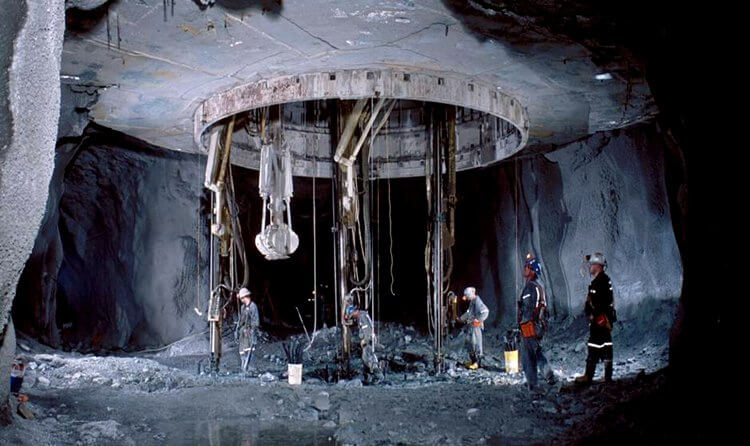
To extract mineral by underground methods of working, the access may be by an incline (a tunnel from surface to the mineral bed), by an adit, or by a well which is called shaft or pit in mining terminology.
Shaft sinking is costly operation. The mining companies pay to the shaft sinking contractors amounts varying from Rs. 5 lac- 10 lac per metre of overall depth of the shaft sunk and this amount includes sinking, lining with concrete, head gear, winding engine, compressors and all the machinery required for sinking and lining upto the final depth (A turnkey job).
Study material for DGMS and other mining engineering exams
WhatsApp channel: Miners Adda
Equipment
The surface plant and equipment required for sinking is as follows:
Steam boilers or diesel engines for winding engine, pumps, etc. unless electric power is available.
Winding engines and winders fitted with locked coil ropes.
Steel headgear. The headgear map be temporary nature and after the sinking is over, it is replaced by a permanent headgear and permanent winders to suit the output.
Double drum winches for walling scaffold, and other winches for lighting cables, shot-firing cables, pump suspension ropes and pump cables.
Air compressors for jack hammer drills used for drilling into rock and other compressed air operated equipment.
Fan of nearly 300 m3 per minute capacity.
Generator with diesel or steam engine for lighting.
Folding doors to cover the shaft top.
Shaft centering arrangement.
Signalling arrangements from pit bottom to pit top and u?w pit top to winding engine.
For disposal of debris, chutes, buckets, and tipping tubs with tramline, etc.
Workshop including smithy shop, mortar mill and other usual machines.
Lamp room, first aid room, magazine, stores, office, etc.
Temporary Lining
It is necessary to support the sides of the excavation to prevent their collapse. A heavy wooden frame or a frame of steel girders is built across the shaft top from which the first (topmost) ring of temporary lining is suspended.
Permanent Lining of shaft sides
When strong rock is reached, the excavation is reduced to the finished diameter of the shaft and continues thus for 3 to 4 m below. Arrangements are then made for construction of permanent lining which may be of brick, concrete etc.
Brick walling is a common practice for ordinarily compact and moderately walling is a common practice for ordinarily compact and moderately wet strata.
Blasting in Sinking Shafts
Although full diameter drilling of shafts has been done in many countries abroad, the normal technique of shaft sinking is drilling, blasting and mucking. The progress of shaft-sinking as in tunnelling is dependent largely on the efficiency of drilling and blasting. A ring of cut holes which are inclined towards the centre are blasted first in the centre which form an inverted pyramid. This is followed by easers and trimmers, the number of rings of easers depending on the diameter of the shaft.
As sinking shafts are normally wet, it is important to use high density, water resistant explosives such as special gelatines, Ajax 'G' and the like.
The hard rock in a sinking pit is blasted with explosives after holes are drilled. The shot-holes are arranged as shown in the given figure.

As a thumb rule it may be stated that the number of holes in a ring is three times the diameter of the ring in metres.
The holes are drilled by hand-held jack hammer drills operated by compressed air.
Blasting of the inner ring is to be carried out first and all the shots in the ring are connected in series.
The shots are connected to a shotfiring cable which is suspended from a reel at the surface. All men are withdrawn, the folding doors closed, and the shots are fired electrically from the surface by a hand operated heavy duty exploder.
When the debris resulting from the blasting of inner ring is being cleared up, holes of outside sumper ring are charged and in this manner the blasting of all the rings is carried out.
Subscribe to our newsletter for updates on DGMS and other mining engineering exam
Study material for DGMS and other mining engineering exams
WhatsApp channel: Miners Adda


Comments