Stages in Mineral Exploration
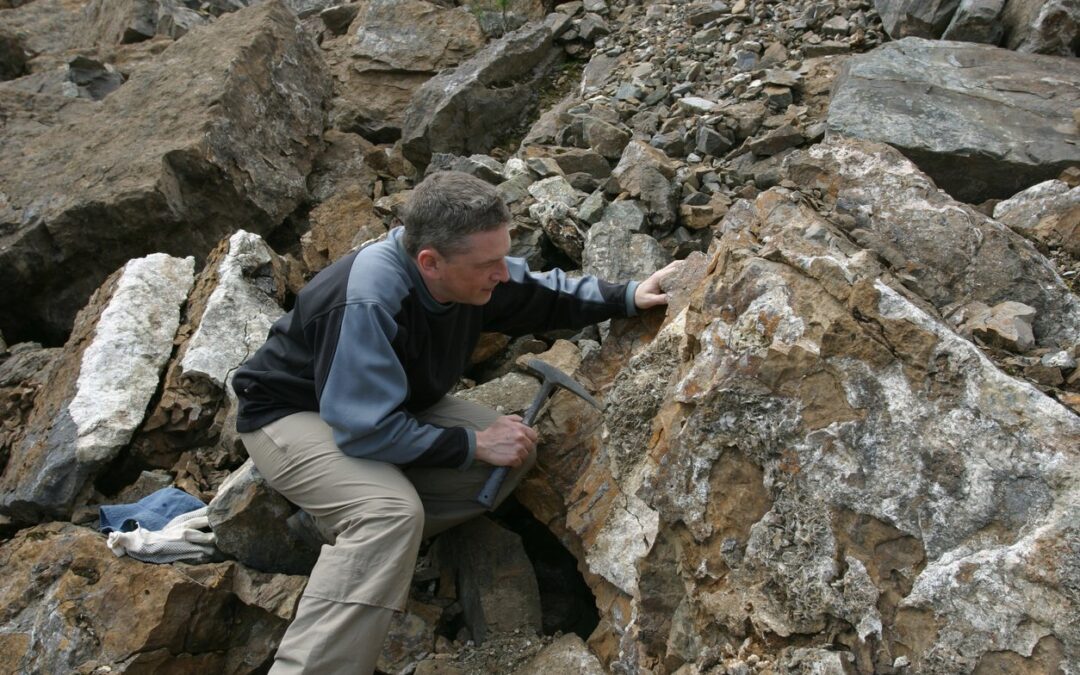
Any exploration program can be classified by successive stages - each stage is designed with a combined specific objective to achieve within the time schedule and allocated fund. The outputs of each stage provide inputs to the next successive stage. The stages for major and with limited application for minor minerals are placed in ascending order with respect to increase geological confidence in the context of any exploratory procedure.
Reconnaissance
"Reconnaissance" is the "grassroots" exploration tor identifying enhanced mineral potential or initial targets on a regional scale. The preparations at this stage include literature survey, acquisition of geophysical data, if any. synthesis of all available data and concepts, and obtaining permission from the State/Provincial/Territorial Government. The activities encompass remote sensing, airborne and ground geophysical survey, regional geological overview, map checking/ mapping on 1:250.000, 1:50.000 scales, geochemical survey by chip/grab sampling of rocks and weathered profiles, broad geomorphology and drainage, pitting and trenching to expose mineralized zone at ideal locations, and limited scout/reverse circulation/diamond drilling to know the possible extent of mineralization. Petrographic and mineragraphic study will help to determine principal host and country rocks and mineral assemblages.
Large Area Prospecting
"Large Area Prospecting", a blend of Reconnaissance and Prospecting License (PL), is initiated in some countries. It combines Reconnaissance and Prospecting activities including general and detailed exploration. It is systematic exploration of potential target anomalies after obtaining Large Area Prospecting License (LAPL) from the State/ Provincial/Territorial Government. The activities encompass detailed geological mapping, rock chip and soil samplings, close-spaced ground geophysics. Reverse Circulation (RC) and diamond core drilling on wide-spaced section lines, and resource estimation of Inferred or Possible category. Other information like rainfall, climate, availability of infrastructures, and logistic facilities including health care and environmental implications are collected. The main objective is to identify a suitable deposit that will be the target for further definitive exploration. The permissible area and duration will be between Reconnaissance and Prospecting.
Prospecting
"Prospecting" is the systematic process of searching promising mineral targets identified during Reconnaissance. The objective is more definitive exploration for increasing geological confidence leading to further exploration.
General Exploration
"General exploration" is the initial delineation of an identified deposit. Methods include mapping on 1:25,000. 1:5000 or larger scale, for narrowing down the drill interval along strike (100-400 in) and depth (50-100 in), detail sampling and analysis tor primary and secondary Commodities, value-added trace and deleterious penalty elements. 10% check sampling and analysis for Quality Assurance/Quality Control, borehole geophysical survey, bulk sampling for laboratory and bench scale beneficiation tests and recoveries and collection of geo-environmental baseline parameters.
The objective is to establish the major geological features of a deposit, giving a reasonable indication of continuity and providing an estimate of size with high precision, shape, structure and grade.
Detail Exploration
"Detail exploration" is conducted before the start of mining phase or mine development. It involves three-dimensional (3D) delineation to outline firm contacts of the ore body, rock quality designation for mine stability, planning and preparation of samples for pilot plant metallurgical lest work. The works envisaged are mapping at 1:5000. 1:1000 scale, close space diamond drilling (100 x 50, 50 x 50 m), borehole geophysics, trial pit in case of surface mining and sub-surface entry with mine development at one or more levels in case of underground mining.
The Mining Lease is obtained at this stage for the purpose of undertaking mining operations in accordance under the Act for major minerals. It shall also include quarrying concessions permitting the mining of minor minerals. ML is granted by competent authority, i.e. the State/Provincial/Territorial Government with the clearance from Federal Ministry of Mines, Ministry of Forest and Environment and Bureau of Mines. The permissible area under ML will be negligible and may be l/l 00th of the Reconnaissance area.
A total span of 15-50 or more years, from beginning to closure of the mining, is conceived for project schedule. Conditions change in this time, and it is a combination of founding foresight, steady perseverance and agility in adaptation, which, along with a good measure of statistical providence provide for project success.
Ongoing Exploration
Diamond drilling is a continuous process throughout the entire life of the mine to supplement reserve for the depleted ore. Exploration continues during the mine development and production. This is primarily conducted by underground diamond drilling to enhance reserve down dip and in the strike direction. The aim of the mine geologist is to replace depleted ore of 1 tonne by 2 tonnes new reserve at the end of each year. This will increase the mine life and continue mining operation. It also upgrades the category of reserve from Inferred to Indicated, Measured and Developed. The drill information helps to precisely delineate ore boundary, weak rock formation and shear zones for mine planning. Geochemical sampling of soil, debris and ground water in wells, streams, and rivers within and around the mining license area is carried out at regular interval for monitoring environment hazards. The process continues beyond the closure of the mines.
Exploration Scheme
Diamond drilling acts as a prime exploration tool. It is expensive and is carried out in a planned logical sequence. The scheme can be divided into a number of phases depending upon the extension, size and complexity of the mineral deposit. The activity in each phase is defined in clear vision with respect to interval of drilling, number of drill holes, meters to drill, time and cost required to achieve the specified objectives. At the close of each phase of activity the results are reviewed with economic benchmark. It' necessary, the activities of next phase are modified or withdrawn from the project for the lime being.
Subscribe to our newsletter for updates on DGMS and other mining engineering exam
Study material for DGMS and other mining engineering exams
WhatsApp channel: Miners Adda


Comments