Posts

Showing posts with the label AMIE - Environmental Pollution and Control in Mines

Environmental Pollution and Control in Mines - short answer questions from AMIE exams (Set 5)

Define the particulate pollutants in the atmosphere and name any four such pollutants. "Particulate matter," also known as particle pollution or PM, is a complex mixture of tiny particles and liquid droplets. Particle pollution is made up of a number of components, including acids (such as nitrates and sulphates), organic chemicals, metals, and soil or dust particles. Particle Pollution includes Dust Dirt Soot Smoke Drops of liquid Give one example for each of point, line and area sources of contamination. Point-source pollution is easy to identify. As the name suggests, it comes from a single place. Non point-source pollution is harder to identify and harder to address. It is pollution that comes from many places, all at once. Factories and power plants can be a source of point-source pollution. A line source, as opposed to a point source, area source, or volume source, is a source of air, noise, water contamination or electromagnetic radiation that emanates from a linear (o...
Environmental Pollution and Control in Mines - MCQs from AMIE exams (Set 4)

1. Atmospheric CO₂ concentration at present is at (a) 300 ppm (b) 330 ppm (c) 360 ppm (d) 400 ppm 2. In the Gaussian plume dispersion studies stability, class ‘B’ represents atmosphere that is (a) moderately stable. (b) moderately unstable. (c) slightly unstable. (d) slightly stable. 3. Greenhouse effect is due to (a) atmospheric CO₂ absorbing sun’s radiation. (b) atmospheric ozone absorbing sun’s radiation. (c) methane absorbing UV radiation in ionosphere. (d) atmospheric CO₂ absorbing reflected radiation from earth. 4. An observer on a level ground standing at a distance of 80 m away from a source receives 100 dBA noise. As the observer shifts to 320 m away from source, the SPL experienced decreases to (a) 90 dB (b) 80 dBA (c) 88 dBA (d) 110 dB 5.  Dissolved oxygen (DO) level in fresh water flowing at 300 L/s is 7 mg/L. DO fall to 5.0 mg/L after the fresh water mixes with an effluent stream having DO of 1.0 mg/L. The flow rate of the effluent stre...

Environmental Pollution and Control in Mines - MCQs from AMIE exams (Set 3)

Image
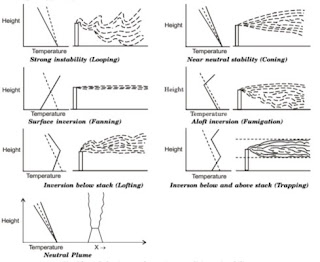
1. An atmospheric radiative window exists between the wavelengths of (a) 7 µm -12 µm (b) 1 µm-3 µm (c) 3 µm - 10 µm (d) 20 µm-35 µm 2. ‘Scaled distance’ as used in prediction of PPV from ground vibrations, contains the following terms: (a) charge per delay, frequency (b) frequency, distance (c) distance, charge per delay (d) frequency, distance, charge per delay 3. Smog formation takes place due to (a) nitrogen oxides. (b) unburnt hydrocarbons. (c) sunshine. (d) All the three above. 4.  Polyacrylamide is a (a) flocculant. (b) coagulant (c) absorbent. (d) drying agent 5. Nitrogen fixing bacteria are found with (a) tubers. (b) legumes.  (c) lemongrass. (d) green leaves. 6. Ozone layer exists in  (a) ionosphere (b) troposphere (c) mesosphere (d) stratosphere 7. If temperature inversion in the atmosphere commences from a level higher than the top of a chimney, the plume will then experience  (a) fanning (b) looping (c) fumigation (d) r...

Environmental Pollution and Control in Mines - MCQs from AMIE exams (Set 2)

Image
1. Greenhouse effect takes place because of the blanketing effect of carbon dioxide allowing (a) short wave length of radiations to pass through it (b) long wave length of radiations to pass through it (c) both short wave and long wave radiations to pass through it. (d) neither long nor short length radiations to pass through it 2. Ozone hole is dangerous because it makes us more exposed to (a) ultraviolet rays. (b) cosmic rays. (c) infrared rays. (d) ultrasound rays. 3. What is photochemical smog? (a) Suspension of carbon particles and dust (b) Chlorophyll of leaves (c) Silver compound (d) hydrocarbons and oxides of nitrogen 4. CO concentration in a mine working should be (a) < 25 ppm (b) < 50 ppm (c) < 100 ppm (d) < 150 ppm 5. Oil-rich and oil-lean compositions of ANFO produce the following gases, respectively: (a) NH₃ and H₂S (b) SO₂ and H₂ (c) CO and NOx (d) NOx and CO₂ 6. The permissible limit for respirable silica dust with particle size below 5 microns in a mine is (...

Environmental Pollution and Control in Mines - MCQs from AMIE exams (Set 1)

Image
Choose the correct answer for the following (2 marks each) 1. The correct sequence of atmospheric layers is (a) stratosphere, mesosphere, troposphere, thermosphere (b) stratosphere, troposphere, mesosphere, thermosphere (c) troposphere, stratosphere, mesosphere, thermosphere (d) troposphere, thermosphere, stratosphere, mesosphere 2. Match the following: Scientist 1. Streeter-Phelps 2. Gifford-Pasquill 3. Dansgaard-Oeschger Area of Work p. Atmospheric stability classes q. Oxygen sag curve r. Cycles of atmospheric cooling and warming (a) 1-q 2-p 3-r (b) 1-p 2-q 3-r (c) 1-r 2-p 3-q (d) 1-q 2-r 3-p 3. Atmospheric radiative window refers to the ––– of the –––– that is free to pass without getting absorbed by atmospheric gases. (a) wavelength band, incoming solar radiation (b) wavelength band, transmitted earth radiation (c) absorptivity, incoming solar radiation (d) absorptivity, transmitted earth radiation 4. Soil texture refers to the relative proportions of –––– in ...