
Boiler Quality Plates
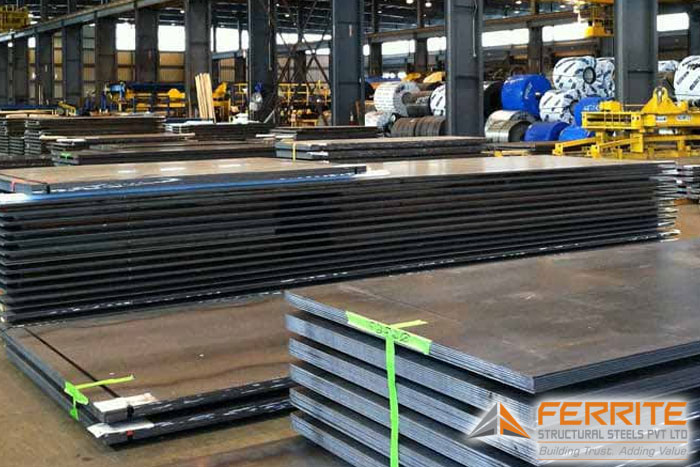
Large cylindrical pressure-holding components like drums, RH headers, blowdown tanks and so on are required to be made from BQ plates.

BQ plate is primarily a very high-quality, fully deoxidised, mild steel (MS) plate of medium to high thickness, suitably alloyed where necessary to withstand high p & t. The essential requirements are

  • Very good weldability
  • Assured and verified high-temperature properties
  • High tensile strength even at high temperatures

BQ plates are available in three classes of metallurgy

  1. CS (low, medium and high C)
  2. Low and medium AS
  3. High AS—not in ASME steels

CS Plates

Low CS has good weldability while high CS has good tensile strength.

The American practice prefers

  • CS for both LP and HP applications and
  • Thick CS to thinner AS drums

The European method is to avoid C > 0.25% and adopt AS plates for HP and have thinner drums.

High CS plates of SA 515, 516 and 299 are extensively used for generally thickness up to ~40, <100 and >100 mm for the three steels, respectively.

Low and Medium AS Plates

SA 302 is a very popular low-alloy American steel employed for high PS & TS. For SH and RH headers of large diameter, when they are required to be rolled out of plates, medium- and high-AS plates are regularly employed.

High AS Plates

High AS plates are not listed in ASME standards but are routinely used in Europe to reduce the drum and header thicknesses. A thin drum is helpful in cycling duty of boilers.

Alloy plates are preferred in European practice.

Boiler Quality Plates to ASME Specification are given below:


Subscribe to our newsletter for updates on Boiler Operation Engineering Exam 

Study material for BOE exams 


Comments

Popular posts from this blog

Mechanics of Fluids (Solved Numerical Problems)

Numerical The surface Tension of water in contact with air at 20°C is 0.0725 N/m. The pressure inside a droplet of water is to be 0.02 N/cm² greater than the outside pressure. Calculate the diameter of the droplet of water. (7 marks) (AMIE Summer 2023) Solution Surface tension, σ = 0.0725 N/m Pressure intensity, P = 0.02 N/m 2 P = 4σ/d Hence, the Diameter of the dropd = 4 x 0.0725/200 = 1.45 mm Numerical Find the surface tension in a soap bubble of 40 mm diameter when the inside pressure is 2.5 N/m² above atmospheric pressure. (7 marks) (AMIE Summer 2023) Answer: 0.0125 N/m Numerical The pressure outside the droplet of water of diameter 0.04 mm is 10.32 N/cm² (atmospheric pressure). Calculate the pressure within the droplet if surface tension is given as 0.0725 N/m of water. (AMIE Summer 2023, 7 marks) Answer: 0.725 N/cm 2   Numerical An open lank contains water up to a depth of 2 m and above it an oil of specific gravity 0.9 for a depth of 1 m. Find the pressure intensity (i) at t...

Geotechnical & Foundation Engineering (Solved Numerical Problems)

Numerical A 1000 cc core cutter weighing 946.80 g was used to find out the in-situ unit weight of an embankment. The weight of the core cutter filled with soil was noted to be 2770.60 g. Laboratory tests on the sample indicated a water content of 10.45 % and specific gravity of solids of 2.65. Determine the bulk unit weight, dry unit weight, void ratio, and degree of saturation of the sample. (AMIE Summer 2023, 8 marks) Solution Weight of soil in core cutter = 2770.60 - 946.80 = 1823.8 g Bulk unit weight, γ t = W/V = 1823.8/1000 = 1.82 g/ccDry unit weight, γ d = γ t /(1 + w) = 1.82/(1 + 0.1045) = 1.65 g/cc Void ratio, e = (G s γ w /γ d ) - 1 = (2.65 x 1.0/1.65) - 1 = 0.61 Degree of saturation, S = wG s /e = (0.1045 x 2.65)/0.61 = 0.4540 = 45.4% Numerical What is the theoretical height of the capillary rise and the capillary pressure in fine-grained soil with an effective size (D 10 ) of 0.002 mm? (AMIE Summer 2023, 4 marks) Solution D 10 = 0.002 mm;  Using the assumption that th...

Energy Systems (Solved Numerical Problems)

Wind at 1 standard atmospheric pressure and \({15^0}C\) has velocity of 15 m/s, calculate (i) the total power density in the wind stream (ii) the maximum obtainable power density (iii) a reasonably obtainable power density (iv) total power (v) torque and axial thrust Given: turbine diameter = 120 m, and turbine operating speed = 40 rpm at maximum efficiency. Propeller type wind turbine is considered. (AMIE Winter 2023) Solution For air, the value of gas constant is R = 0.287 kJ/kg.K 1 atm = 1.01325 x 10⁵ Pa Air density \(\rho  = \frac{P}{{RT}} = \frac{{1.01325x{{10}^5}}}{{287}}(288) = 1.226\,kg/{m^3}\) Total Power \({P_{total}} = \rho A{V_1}^3/2\) Power density \(\begin{array}{l}\frac{{{P_{total}}}}{A} = \frac{1}{2}\rho {V_1}^3\\ = \frac{1}{2}(1.226){(15)^3}\\ = 2068.87{\mkern 1mu} W/{m^2}\end{array}\) Maximum power density \(\begin{array}{l}\frac{{{P_{\max }}}}{A} = \frac{8}{{27}}\rho A{V^3}_1\\ = \frac{8}{{27}}(1.226){(15)^3}\\ = 1226{\mkern 1mu} W/{m^2}\end{array}\) Assuming eff...