Calorific Values of Fuels
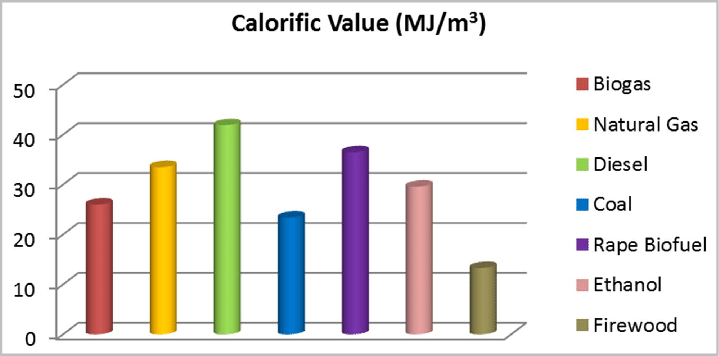
A fuel generally has the number of constituents. Some constituents react exothermally and thereby generate heat, and some others do not react chemically at all. The heat generated due to combustion of a unit mass of solid (or liquid) fuel is called its calorific value and is expressed in terms of kJ/kg. For gaseous fuels, the calorific value is expressed as heat liberated by combustion of unit cubic metre of gas at standard temperature and pressure (150C and 760 mm of mercury).
Gross Calorific Value (GCV) or Higher calorific value (HCV) of fuel
If the combustion products are cooled back to the initial temperature (usually specified as 15°C), the water vapours get condensed and that liberates the latent heat. Obviously, then the maximum amount of heat is produced, and this maximum heat is called the higher calorific value (HCV) of fuel.
Join our WhatsApp Channel - BOE Adda for regular updates
Consider unit mass of solid fuel consisting of C kg of carbon, H kg of hydrogen, S kg of sulphur and O kg of oxygen. Further let the individual calorific value of carbon be 33900 kJ/kg, of hydrogen be 144000 kJ/kg and of sulphur be 9290 kJ/kg. Then higher calorific value of fuel will be
HCV = (33900 C + 144000 H + 9290 S) kJ/kg when no oxygen is present.
In case some oxygen is also present in fuel, then
HCV = (33900 C + 144000 [H - (O/8)] + 9290 S) kJ/kg
Note: Dulong has suggested the following empirical formula for calculating the HCV of fuel
HCV = (33800 C + 144000 [H - (O/8)] + 9290 S) kJ/kg
Net Calorific Value (NCV) or Lower calorific value (LCV) of fuel
If the cooling of combustion products to room temperature is not possible, then there is no condensation of water vapour and the associated heat is carried to the atmosphere. The heat then available for heating purposes and commercial use is less than the total heat evolved by the combustion of fuel. This heat is called the lower calorific value (LCV) of fuel.
LCV = HCV - heat carried by water vapour formed per kg of fuel burnt.
From the chemical reaction 2H2 + O2 = 2H2O, it is seen that 4 kg of hydrogen combine with 32 kg of oxygen to form 36 kg of water vapour. That is the water vapour formed is 9 times the mass of hydrogen in fuel.
LCV = HCV - 9H x hfg
where hfg = 2460 kJ/kg is the latent heat of steam at saturation temperature of 15°C.
Example
Estimate the higher and lower calorific values of a fuel having the following composition by mass:
C = 88%
H2 = 10%
O2 = 3%
S = 2%
N2 = 20%
and the rest is incombustible matter.
Solution
Using Dulong formula
HCV = 33800 x 8 + 144000[0.1 - (0.03/8)] + 9270 x 0.02
= 41085 kJ/kg
Amount of steam (water vapour) formed = 0.1 x 9 = 0.9 kg/kg fuel
Heat absorbed in formation of steam = 0.9 x 2460 = 2214 kJ
\ LCV = 41085.4 – 2214 = 38871.4 kJ/kg
Subscribe to our newsletter for updates on Boiler Operation Engineering Exam
WhatsApp channel "BOE Adda"


Comments